




















Most people see their first hint of smoother skin within two to three days of a Botox injection, but the treatment takes close to two weeks to fully settle into the muscle. That gap exists because Botox works on the nerve signal that triggers movement, not on the skin itself, so the change shows up gradually rather than all at once.
So how long does Botox take to work for you, specifically? It comes down to a few variables: which muscle is treated, how much product your injector uses, and how your body responds. Those differences explain why one patient sees results by day 5 while another is still waiting at day 9, both within the normal range.
Quick Answer: expect the first softening around day 2 to 3, visible smoothing by day 5 to 7, and your final result between day 10 and 14. Give it the full two weeks before judging the outcome or asking about a touch-up.
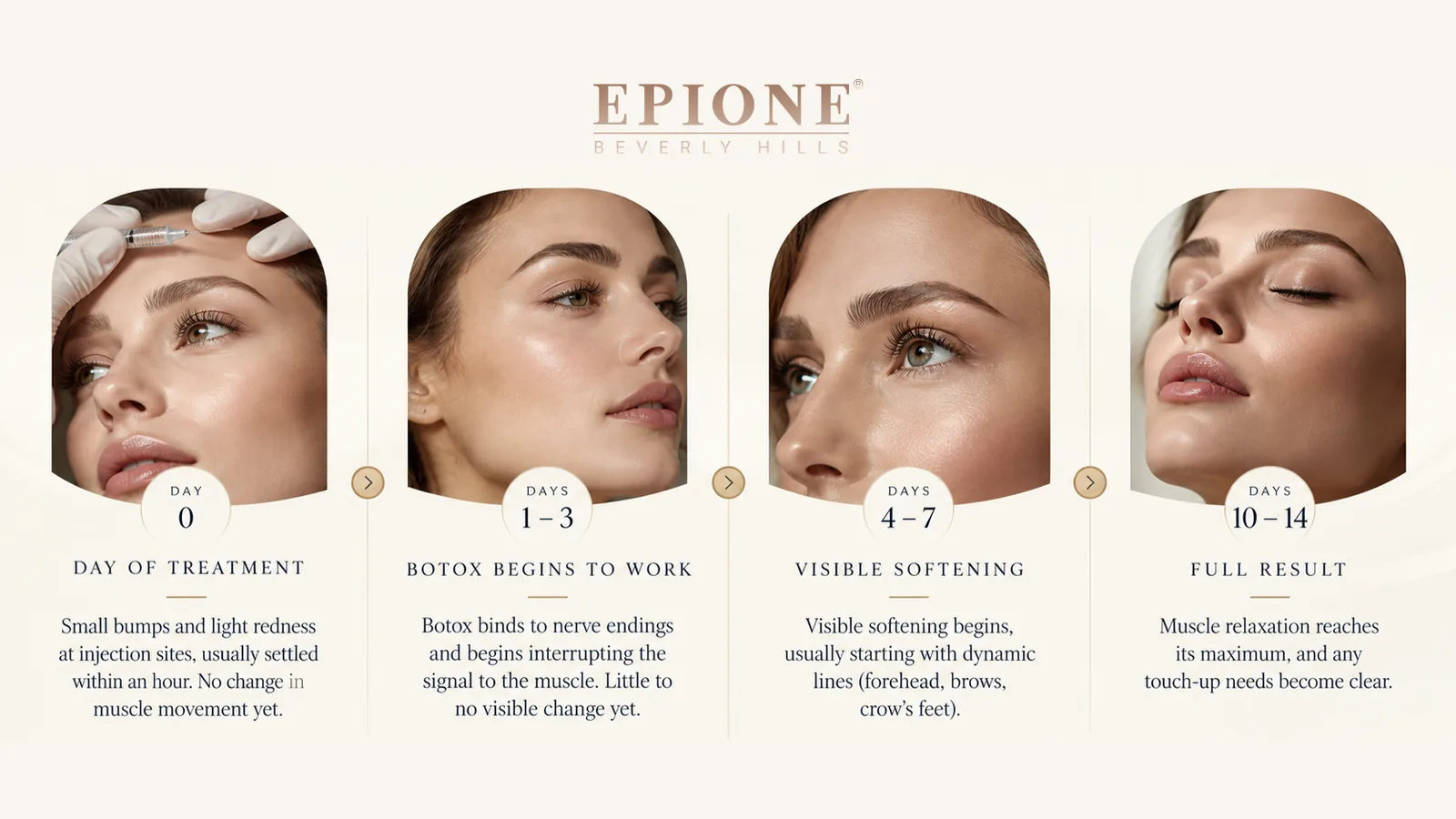
The Botox Timeline: Day-By-Day
Each stage of this process brings a distinct, predictable shift in how your muscles respond, and knowing what’s happening beneath the surface at each point makes the two-week wait easier to sit through.
Day 0 (Day of Treatment)
Small bumps typically appear at each injection site, along with some light redness, and both usually settle within an hour after you leave your appointment. Muscle movement looks and feels the same as when you walked in, because the toxin hasn’t yet reached the nerve endings it needs to bind to. Any tightness you notice at this stage is from the injections themselves, not from Botox taking effect.
Days 1 to 3
This window is the binding phase, where Botox attaches to the nerve endings in the treated muscle and begins interrupting the signal that triggers contraction. Most patients notice little to no visible change during these first few days, even though the process is actively underway beneath the skin. Some people report subtle heaviness or stiffness in the treated area, a normal early sign, not a cause for concern.
Days 4 to 7
Visible softening tends to begin somewhere in this window, usually starting with dynamic lines, the ones that form when you raise your brows, squint, or frown. Static lines, the creases still visible when your face is completely at rest, take longer to respond and often show less dramatic change at this stage. One side of the face may also soften a bit faster than the other, which typically evens out as the week progresses.
Days 10 to 14
By this point, most patients have reached their full result, with the treated muscle at or near its maximum level of relaxation. This is when an experienced injector can accurately assess whether the dose and placement delivered the intended outcome, rather than guessing based on a partial result. If anything still looks uneven or underwhelming by day 14, flag it now rather than waiting any longer. Clinical research on botulinum toxin places full cosmetic efficacy at roughly two weeks post-injection, with effects commonly lasting three to five months.
What Determines How Fast You See Changes?
- Muscle strength and size. Thicker muscles, like those across the forehead, take a bit longer to fully relax than the finer muscles around the eyes.
- Dose and placement. Botox is not one-size-fits-all. Too little product, or placing it slightly off the target muscle, slows visible results and is one of the most common reasons patients feel underwhelmed at the two-week mark.
- Which neuromodulator you use. Botox, Dysport, and Xeomin all work the same way, but Dysport is often reported to show initial movement a day or two sooner. The products aren't interchangeable unit for unit, which is why dosing experience matters.
- Treatment history. Patients on a consistent schedule tend to see results faster with each session, since the muscle is already partially trained to relax.
When Should You Book Before a Big LA Event?
If you are booking around awards season, a wedding, or a holiday event, build in the full two weeks, and ideally closer to three or four if there is any room in your calendar. January through March is red carpet season across Los Angeles, and April through June brings wedding and event season, both of which fill injector calendars quickly. Booking early also leaves room for a follow-up appointment if your injector wants to fine-tune anything before the big day.
Is It Normal If Something Feels Off?
It is normal to see one side soften before the other in the first week. It is not normal to see no change at all by day 14. If that happens, the most likely explanation is a conservative dose for your muscle strength, which an experienced injector can usually correct with a small touch-up rather than a full re-treatment. Static lines, the deep ones visible even when your face is at rest, will soften with Botox but may never disappear completely, since Botox treats muscle movement rather than the skin itself.
Why Dr. Ourian’s Approach Changes What You Can Expect

Botox timelines vary most when dosing and placement are inconsistent, and that’s precisely where two decades of specialized experience changes the outcome. As a cosmetic dermatologist in Beverly Hills, Dr. Simon Ourian has treated thousands of patients over more than 20 years, a volume of hands-on injecting that translates directly into more predictable, evenly distributed results from the first visit rather than the third. His work has been featured in Forbes, E! Online, and The Globe and Mail, and he’s widely known as the dermatologist Kris Jenner and other A-list clients turn to for natural-looking, not overdone, results whether they’re seeking Botox in Los Angeles or a more involved treatment plan. That reputation isn’t built on volume alone; it’s built on precision dosing that determines whether your results show up evenly on day 7 or unevenly on day 14.
Find Out What Your Own Timeline Will Look Like
The most accurate way to know how your face will respond is to consult someone who can assess your muscle strength and treatment history before the first injection, so book a consultation at Epione to build a timeline around your anatomy rather than a general estimate.
FAQs About How Long Botox Takes to Work
How long does Botox take to work for most patients?
Most people see the first softening within 2 to 3 days, visible smoothing by day 5 to 7, and the full result between day 10 and 14.
Can Botox work in 24 hours?
Some patients notice subtle tightness within the first day, but visible wrinkle smoothing typically doesn't begin until day 2 or 3.
Why does full Botox take about two weeks?
Botox has to bind to nerve endings and fully block the signal that triggers muscle contraction, a process that happens gradually rather than all at once. Clinical literature consistently places full cosmetic efficacy around the two-week mark.
Does Dysport work faster than Botox?
Many patients notice Dysport’s initial effects about a day or two sooner than Botox, though the final result and how long it lasts are generally comparable between the two.
What if my Botox has not changed anything after two weeks?
This usually means the dose was conservative for your muscle strength rather than a sign the treatment did not work. A short touch-up with your injector typically resolves it.
How long will results last once they fully kick in?
Most patients see results last three to four months, with some maintaining them closer to five or six months, depending on the treated area and how consistently they keep up with treatment.
Disclaimer Regarding Treatment Comparisons and AI-Generated Content
The opinions and comparisons expressed in this article are based on Dr. Simon Ourian's professionalexperience, clinical observations, aesthetic philosophy, and publicly available information at the timeof publication.
References to competing products, technologies, procedures, practitioners, or manufacturers are notintended to disparage any individual, company, or organization. Any comparisons reflect Dr. Ourian'sopinions and clinical experience and should not be construed as statements of fact regarding thesuperiority, inferiority, safety, efficacy, or performance of any competing product or treatment.Medical technologies, scientific research, treatment protocols, and regulatory guidance continue toevolve. Information presented in this article may become outdated over time and should not beconsidered comprehensive or definitive medical guidance.
Comparisons between products, procedures, technologies, treatment approaches, manufacturers, oraesthetic outcomes are provided for informational and educational purposes only. Individualpractitioners may have different experiences, preferences, treatment protocols, and opinionsregarding the products or procedures discussed.
No statement contained in this article should be interpreted as a guarantee, warranty, prediction, orpromise of any specific result. Individual outcomes vary significantly based on anatomy, age, skinquality, medical history, genetics, lifestyle factors, treatment technique, and adherence to pre- andpost-treatment instructions.
Portions of this article may have been generated, assisted, summarized, or edited using artificialintelligence (AI) tools. While reasonable efforts have been made to review and verify the content foraccuracy, completeness, and relevance, some information may be incomplete, outdated, inaccurate,or subject to interpretation. Readers should independently verify any information before relying uponit.
The content provided is for general educational and informational purposes only and is not intendedas medical advice, diagnosis, or treatment. Readers should consult with a qualified healthcareprofessional regarding their individual circumstances and treatment options before making anymedical or aesthetic decisions.
Results vary from patient to patient. No outcome is guaranteed. Some or all of this contentmay have been created, edited, or enhanced using artificial intelligence technology, anddespite review efforts, inaccuracies may exist.